
Every Byte Matters
DT pCloud Migrator Tool
Move Files Between pCloud and Any Cloud, Personal or Business, With No Data Limit
DT pCloud Migrator Tool is a Windows desktop tool that moves files and folders between a pCloud account and any other cloud account, or between two pCloud accounts. It supports personal and business accounts on both sides, in both directions, across 15+ clouds. You sign in, preview, map, configure and run, with no manual download and upload cycle and no data size limit on the licensed version.
- Migrate from pCloud to Google Drive, OneDrive, Dropbox, Box, MEGA, S3 and more, or from any of them into pCloud
- Personal pCloud and pCloud Business accounts, including pCloud to pCloud moves
- Preview before you move, filter by extension, date, folder type and size, map manually or in bulk with a CSV
- Resumable, incremental and scheduled runs, with a full job report for every migration


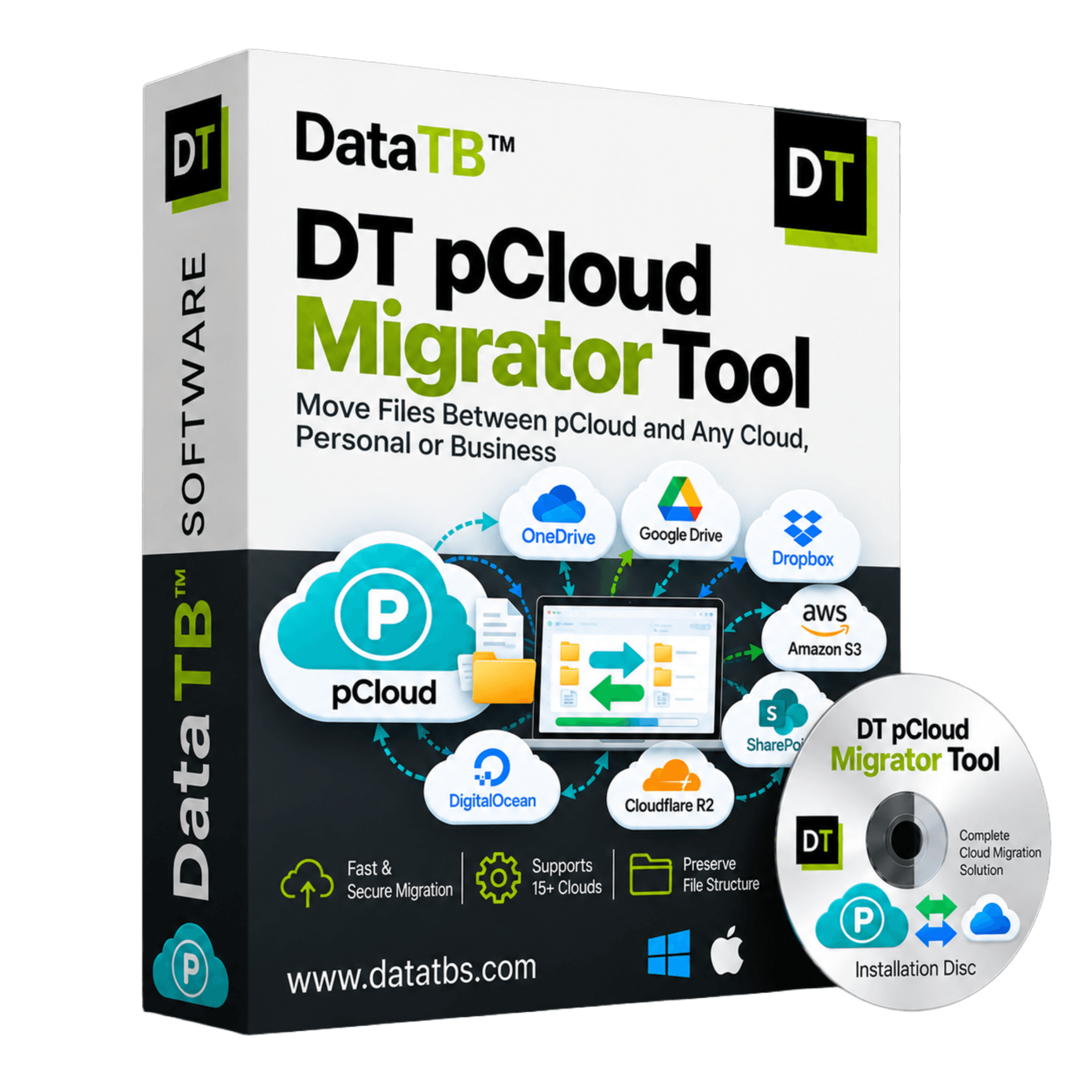
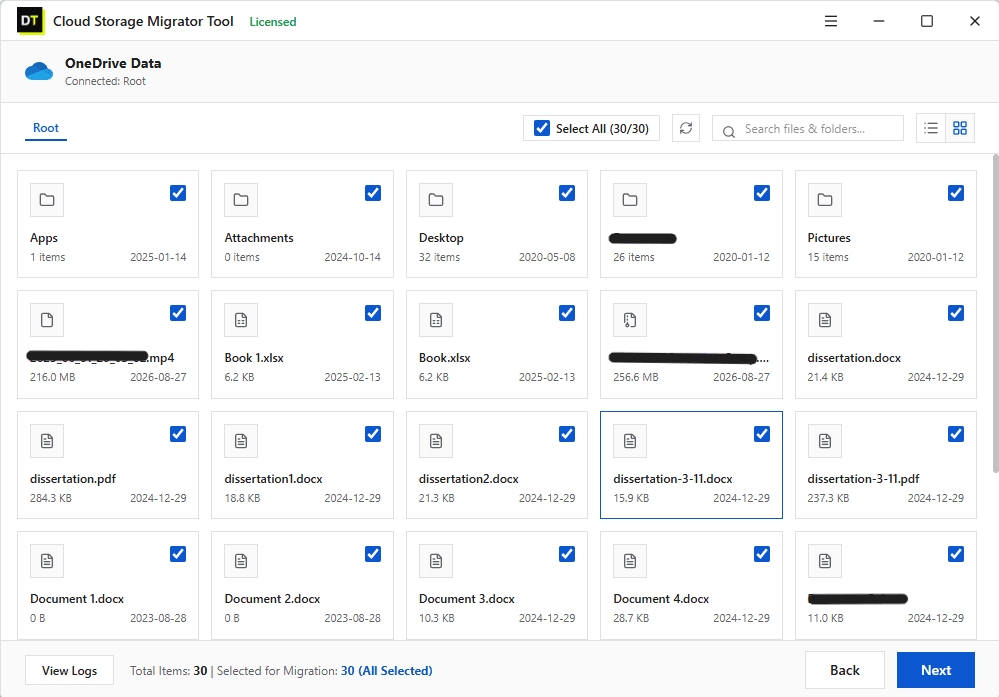
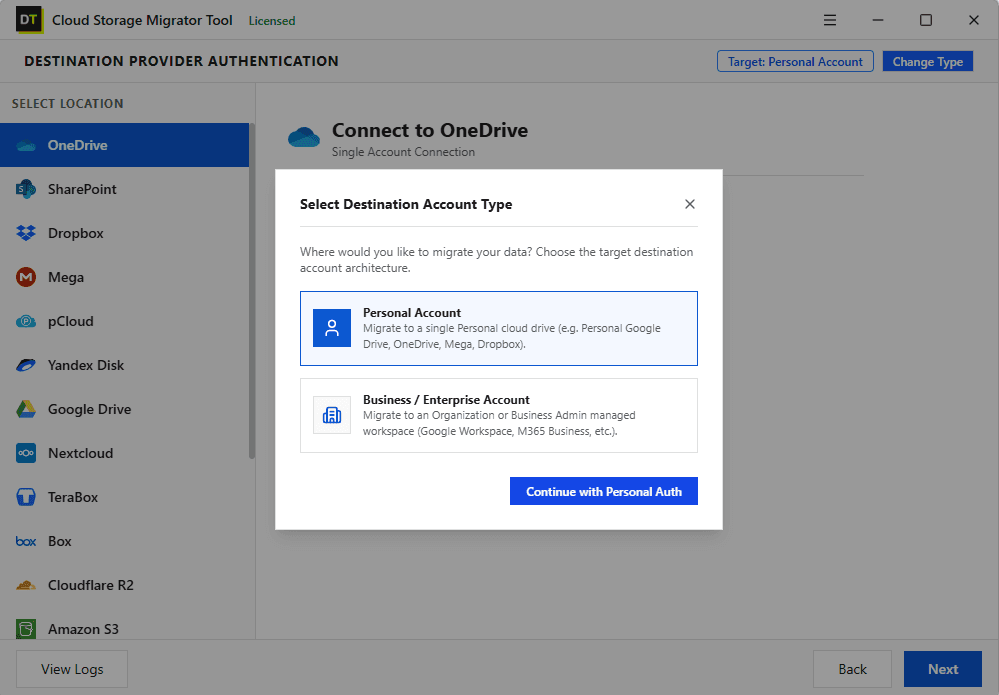
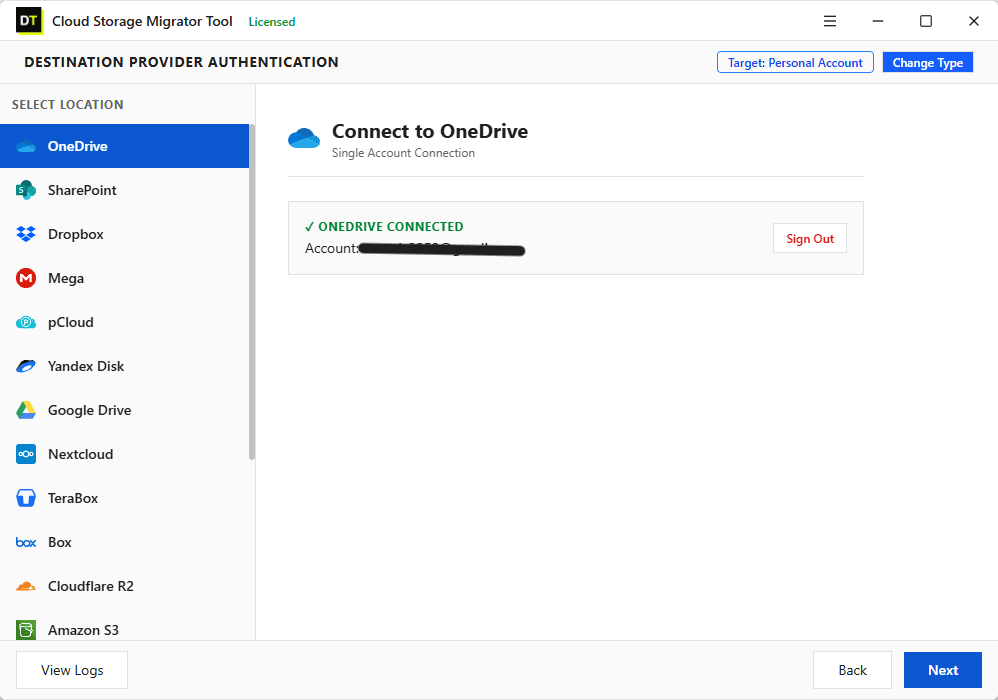
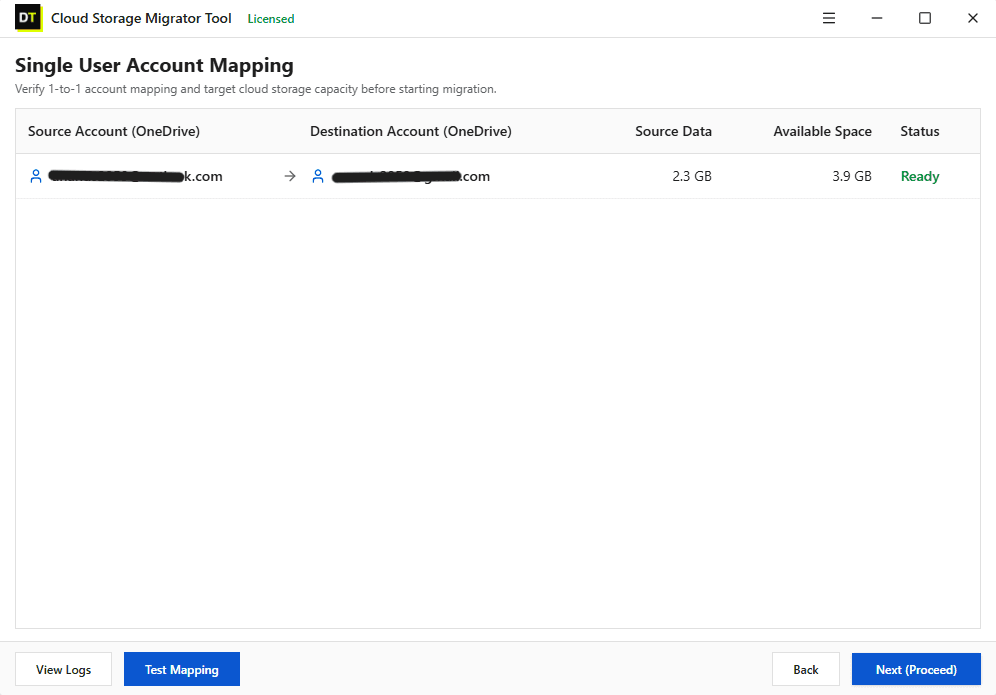
Quick summary:DT pCloud Migrator Tool is a desktop application that moves data between pCloud and 15+ other cloud platforms. It works with personal and business accounts, handles cross-platform moves and pCloud to pCloud moves, supports CSV bulk mapping, and keeps your folder structure intact. Transfers resume after interruptions and every run ends with a detailed report.
Supported Cloud Destinations
Migrate pCloud to Any Major Cloud












Why People Move Out of pCloud, and Into It
pCloud is popular for a reason. It offers lifetime plans, a virtual drive that shows up on your PC, a Crypto folder for private files and servers in both Europe and the United States. Then things change. A team standardizes on Microsoft 365 or Google Workspace. A client project lives in pCloud while your workflow lives somewhere else. A lifetime plan holder wants a second copy outside pCloud. Or the opposite happens, and years of files from Google Drive, Dropbox or OneDrive need a permanent home in pCloud.
The usual fix is slow. You download everything to your PC, wait, then upload it again to the new cloud, using your own disk space and your own internet twice. For a few gigabytes that is an annoyance. For a few hundred it costs a weekend, and a dropped connection means starting over.
DT pCloud Migrator Tool replaces that cycle with one guided job. You pick the source, pick the destination, check what will move, and let the tool run it, with the original folder structure preserved and a report at the end.
Every Direction, Every Account Type
pCloud moves come in more shapes than "pCloud to Google Drive". The tool treats all of them as normal migration paths.
| Direction | Typical situation | What you do |
|---|---|---|
| pCloud to Google Drive | Switching to Workspace, sharing with a Google-based team | Connect pCloud as source and Google Drive as destination |
| pCloud to OneDrive or SharePoint | Moving into Microsoft 365 | Connect pCloud as source and OneDrive or SharePoint as destination |
| pCloud to Dropbox, Box, MEGA | Consolidating personal or team storage | Connect both accounts, preview, map and run |
| pCloud to S3, Azure Blob, Backblaze B2, R2 | Archiving to object storage | Connect pCloud and the bucket, map to a bucket path |
| Google Drive, OneDrive or Dropbox to pCloud | Building a long-term archive in pCloud | Connect the other cloud as source and pCloud as destination |
| pCloud to pCloud | Merging two accounts, handing over a project, moving between personal and business | Connect both pCloud accounts and map folder to folder |
The steps are the same in every row. You never switch tools or learn a second process for a different pair of clouds.
Personal pCloud and pCloud Business Accounts
pCloud has personal plans and a business offering, and the two get used very differently. A personal account usually means one person and one set of folders. A business account usually means shared team folders, several users and a reason to move data in a controlled way.
The tool supports both on either side of a job. That gives you all four account paths:
- Personal to personal: leaving pCloud for another provider, or merging two private accounts
- Personal to business: moving your own files into a company pCloud, OneDrive, SharePoint or Google Workspace drive
- Business to personal: an employee keeping files they are authorized to keep
- Business to business: company to company, or pCloud Business to Microsoft 365 or Google Workspace
Only move data you are authorized to move. For business sources, run the migration with your organization's approval.
15+ Clouds, One Installer
Use any supported cloud as a source or a destination, alongside pCloud or instead of it.
Consumer & Team
pCloud, Google Drive, OneDrive, Dropbox, Box, MEGA, Proton Drive, Yandex Disk, TeraBox, Nextcloud
Business & Collaboration
SharePoint, Google Workspace, Microsoft 365 drives
Object Storage
Amazon S3, Cloudflare R2, Google Cloud Storage, Azure Blob Storage, Backblaze B2, DigitalOcean Spaces
Servers & Networks
FTP, SFTP, network drives
There is no separate app per provider. One installer covers all of them.
What pCloud's Built-In Transfer Does, and Where a Migrator Helps
pCloud offers its own import and backup features that can pull files from a few popular clouds into pCloud. They are a good starting point for a small move into pCloud, and you should use them if they cover your case.
The gaps show up in the situations below, and this is where a dedicated migrator earns its place:
- Moving out of pCloud. Built-in import tools are designed to bring data in. Leaving pCloud for Google Drive, OneDrive or S3 needs a tool that treats pCloud as a source.
- Moving between two pCloud accounts. Merging a personal and a business account is not what an import feature is built for.
- Control over the job. Preview, filters by extension, date and size, skip, rename or replace rules, CSV mapping, incremental runs, schedules and a report you can keep.
- Clouds beyond the usual list. S3, Azure Blob, Backblaze B2, Cloudflare R2, Nextcloud, SFTP and more, in the same tool.
Stop Counting Gigabytes. Start Moving Data.
Most cloud migrations do not fail because the files are hard to move. They stall because the tool around them is built for small jobs. A free plan runs out of monthly transfer quota halfway through a folder. A paid plan prices by user or by gigabyte, so a bigger move means a bigger bill. A feature you need, like bulk mapping or scheduling, sits on a higher tier.
DT pCloud Migrator Tool is built so none of that happens. The licensed version has no data size limit. Every feature ships in the same build: preview, filters, CSV mapping, version migration, scheduling, incremental runs and full job reports. A freelancer moving one pCloud folder and an IT team moving a department get the identical, complete product.
pCloud Details Worth Knowing Before You Migrate
A few things are specific to pCloud, and knowing them up front saves surprises.
Crypto folder
pCloud Crypto uses client-side encryption. Files inside it are protected on pCloud's side with a key only you hold. Unlock the folder before you migrate, and understand that files arriving in another cloud are stored under that cloud's own security model, not pCloud's. Keep a copy of anything that must stay encrypted.
Shared links do not travel
Public links and shared folder settings belong to pCloud. After a migration, recreate the links and permissions you need in the new cloud.
EU and US data regions
pCloud accounts live in either the European or the United States data region, and you sign in to the region your account was created in. Pick the matching region when you connect.
pCloud Drive
If you use the pCloud virtual drive on your PC, the tool still works cloud to cloud and does not read files through that drive.
Lifetime plans
Moving a copy of your data to a second cloud is a sensible backup step even if you plan to stay on pCloud. An incremental job keeps the copy current.
The Complete Migration Workflow: Eight Screens, Nothing Hidden
Every pCloud migration follows the same eight screens. You always know where you are, what comes next and what is about to happen to your data.
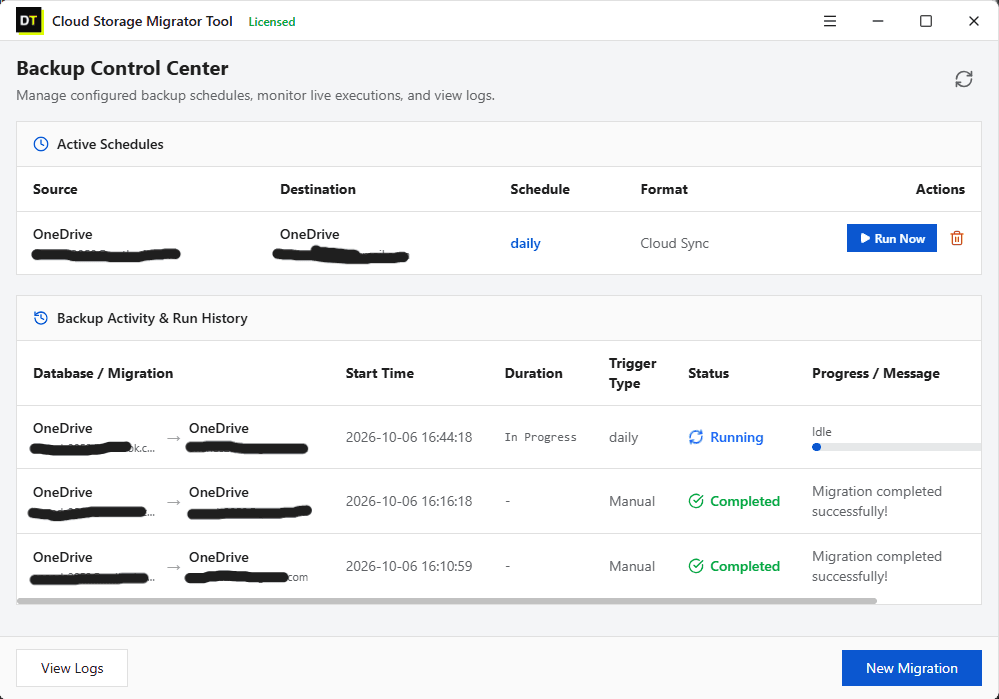
Screen 1: Dashboard
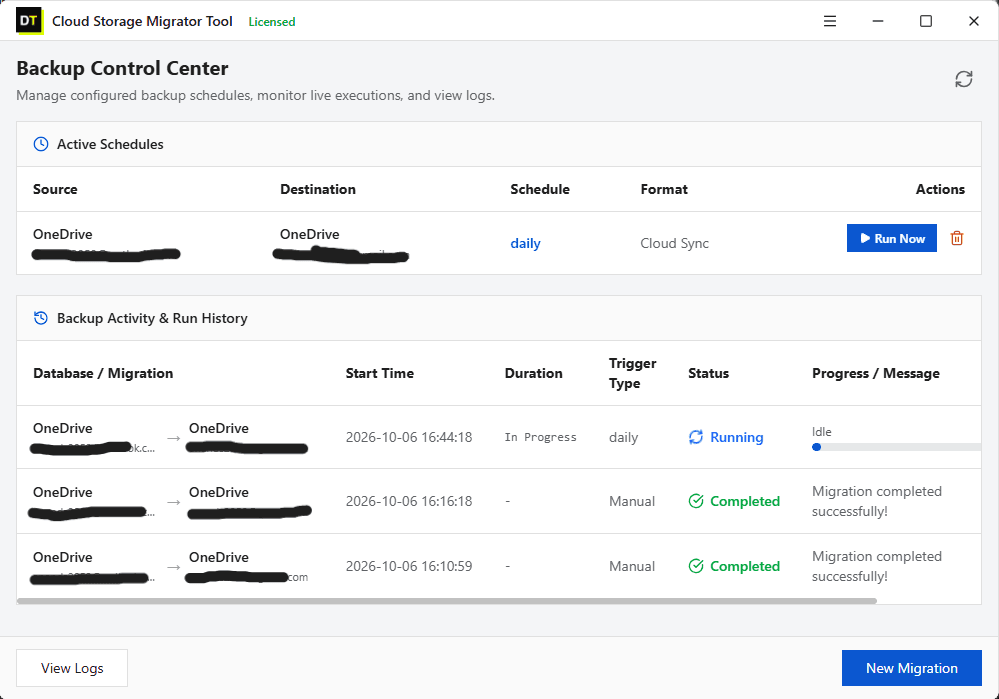
The dashboard is your starting point. From here you begin a new migration job, review the accounts you have connected and reopen earlier jobs and their reports. A job can carry several accounts, drives or folders at once, so a pCloud account with many top-level folders does not need to be moved one piece at a time.
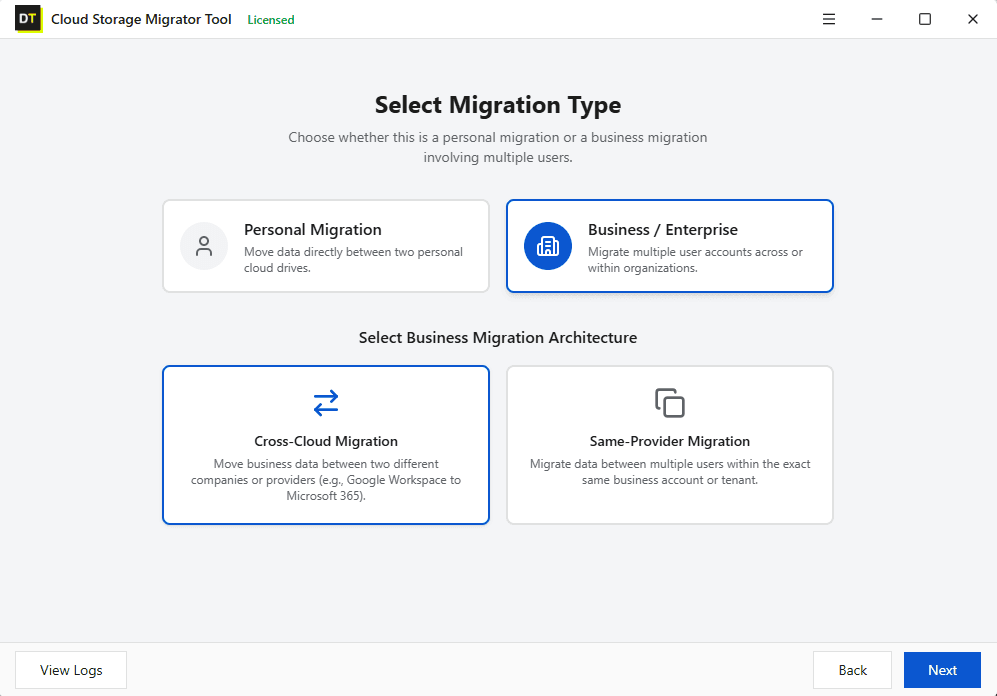
Screen 2: Mode Selection
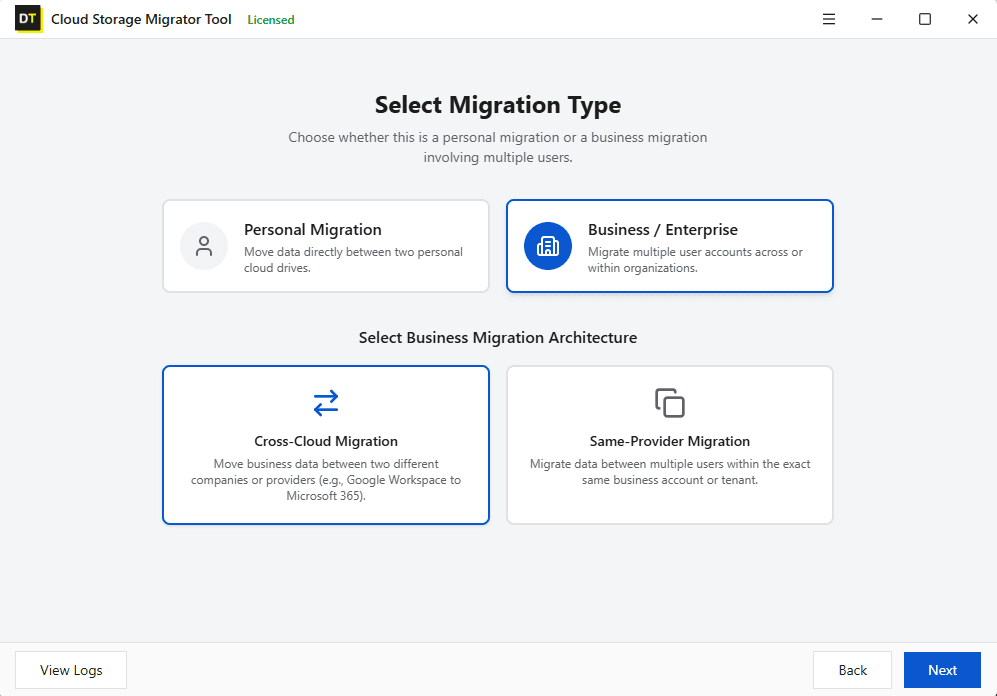
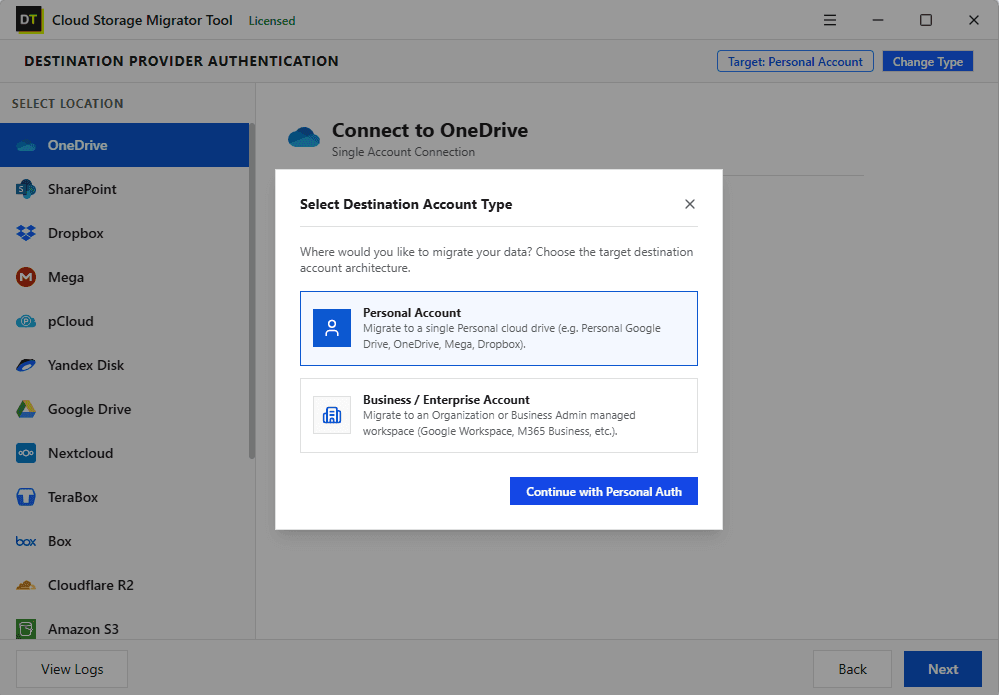
Choose personal or business mode for the job. In business mode you get two more options: cross migration to move data between different platforms, such as pCloud to Google Workspace, or same migration to move data within one platform, such as one pCloud account to another.
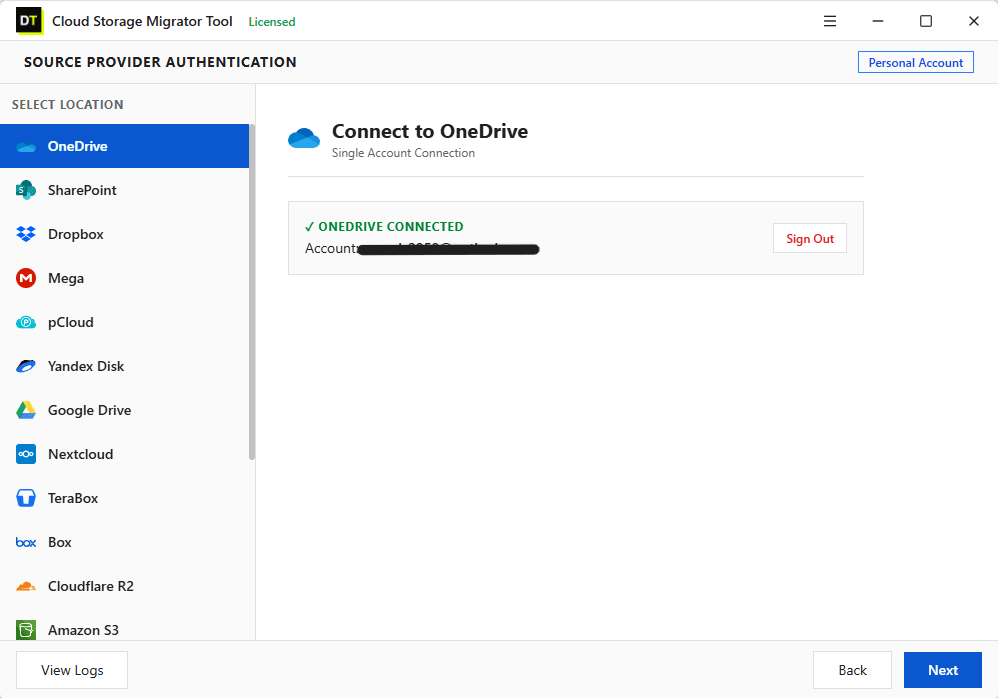
Screen 3: Source Authentication
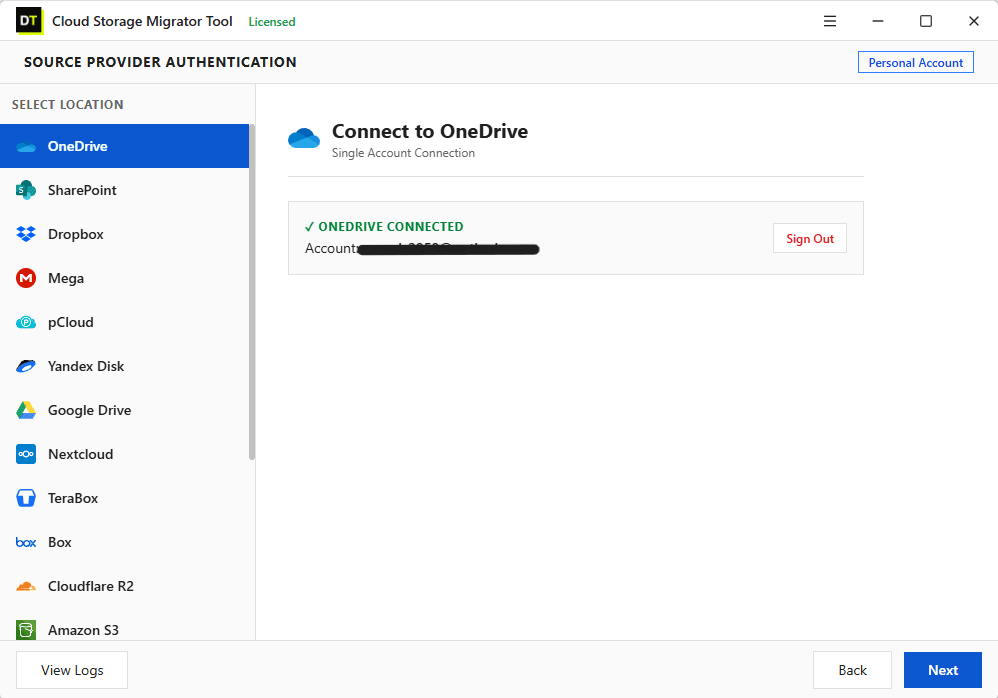
Choose the cloud you are moving from and sign in. If your source is pCloud, you connect your pCloud account here. Add as many source accounts as the job needs and manage them together.
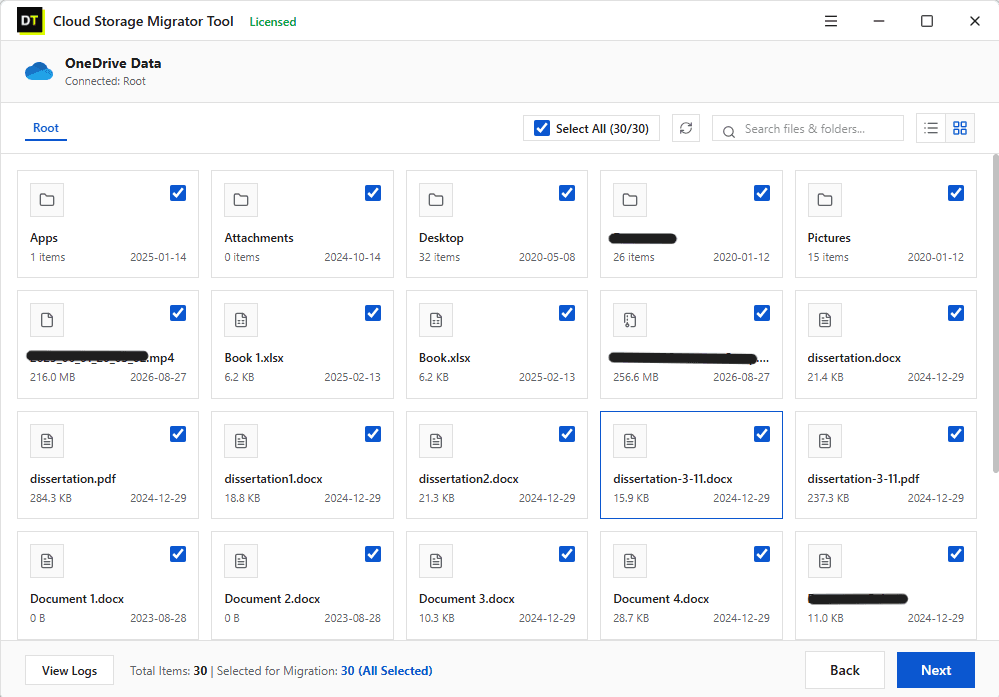
Screen 4: Preview
Before a single file moves, you see exactly what is there. Browse the full folder tree with per-file details: size, created date, modified date and drive type. Then narrow the scope by file extension, date range, folder type or file size. Nothing is committed on this screen, so you can explore and adjust freely. It is the cheapest insurance in any pCloud migration.
Screen 5: Destination Authentication
Choose where the data is going and sign in. The destination can be another provider or a second account on the same provider, personal or business. Browse the destination's existing structure so you know where things will land. Moving from pCloud into a company SharePoint library, or from Google Drive into a private pCloud, is the same two sign-ins.
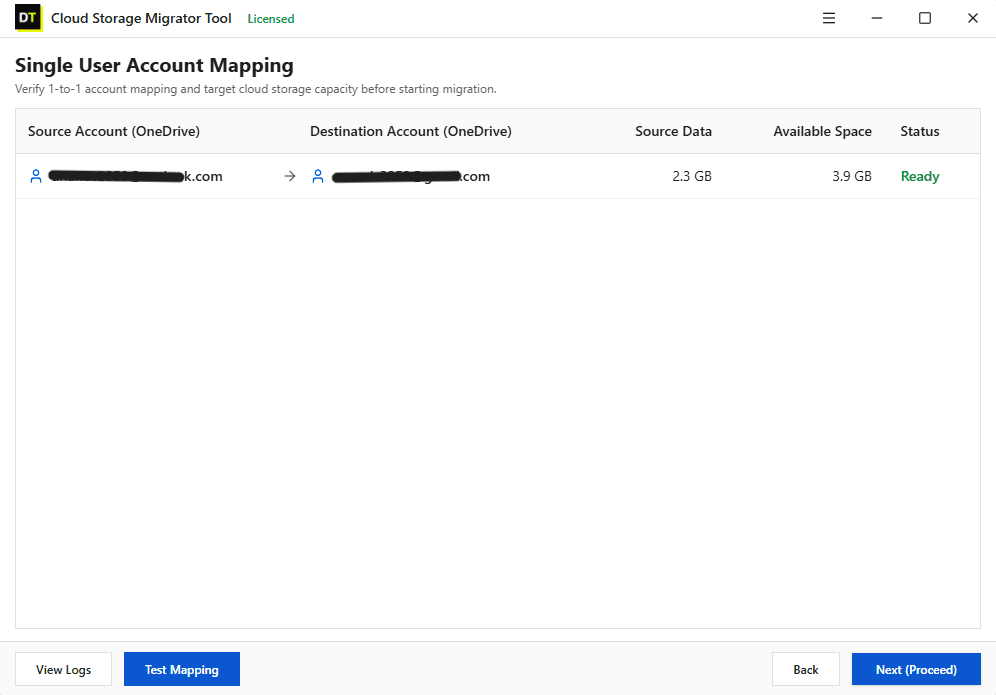
Screen 6: Mapping
Mapping decides which source goes to which destination. For a small job, map accounts, drives or folders manually in a few clicks. For a larger one, upload a CSV file and map dozens or hundreds of accounts in a single step. A company-wide move that would take hundreds of manual selections becomes one file and one upload.
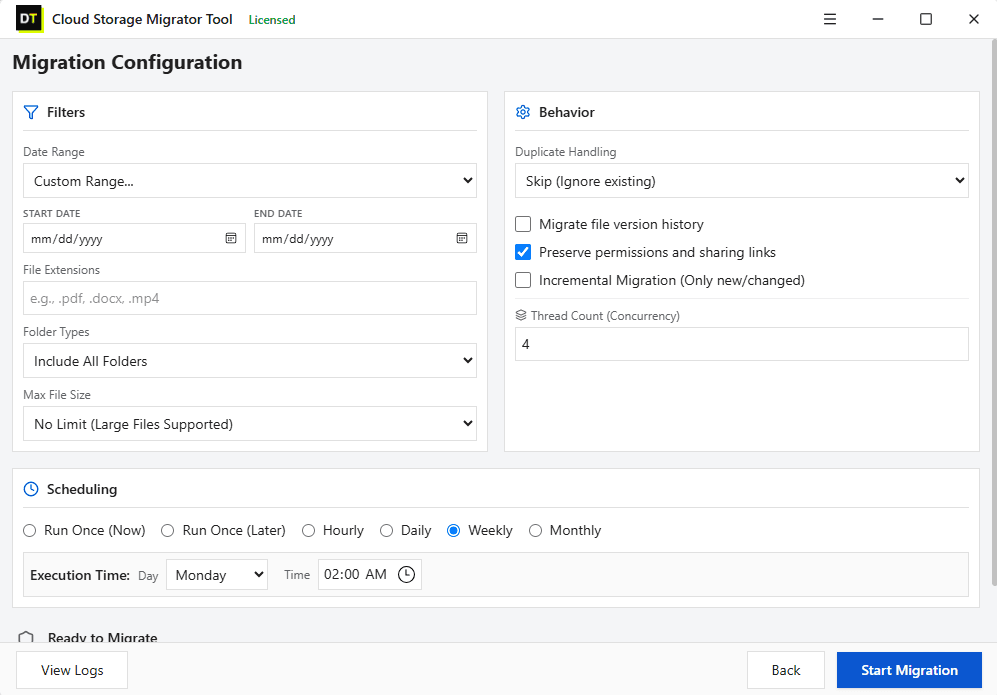
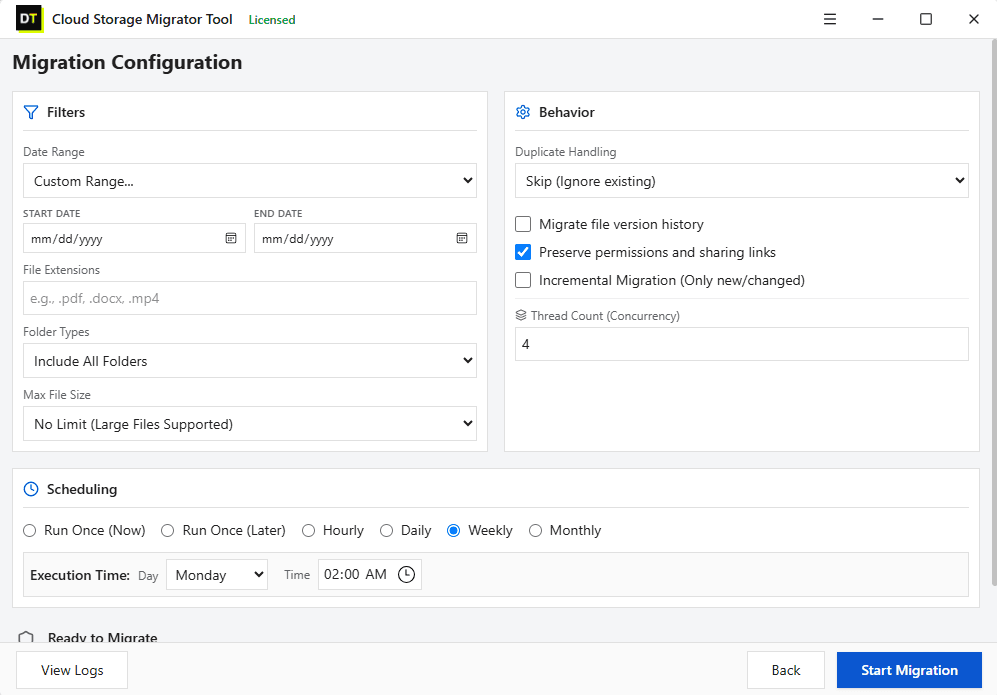
Screen 7: Configure Migration
Set the rules for the run. Decide what happens when a file already exists at the destination: skip it, rename the incoming copy so both exist, or replace the existing file. Turn on version migration to carry file history across where the source keeps it. Choose a one-time run, an incremental run, or a schedule that repeats hourly, daily, weekly or monthly. Adjust thread count and item thread count to match your internet speed and your PC.
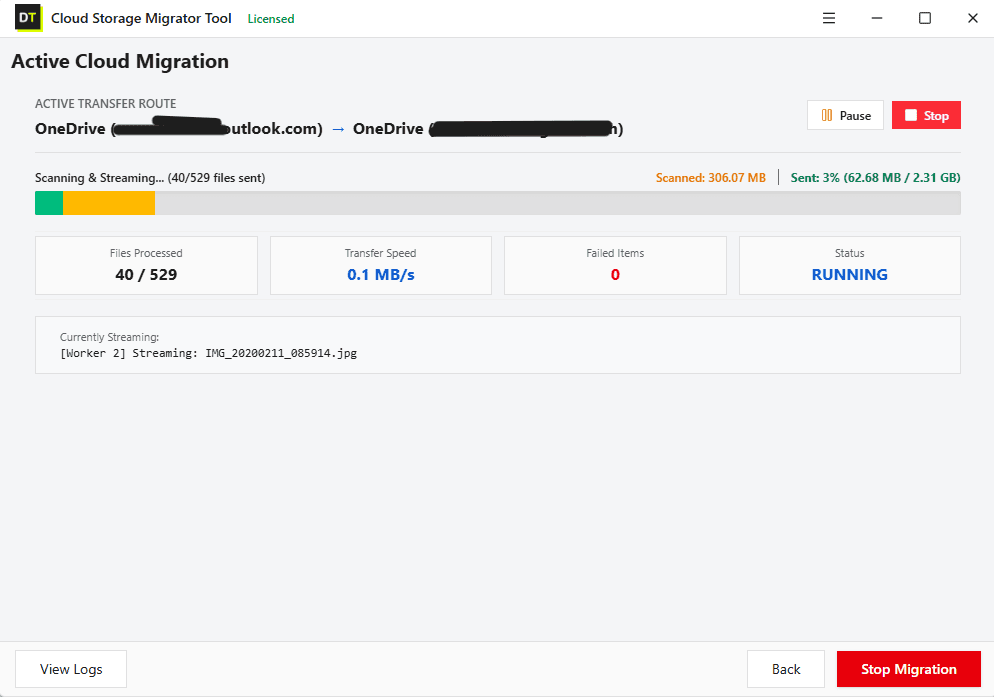
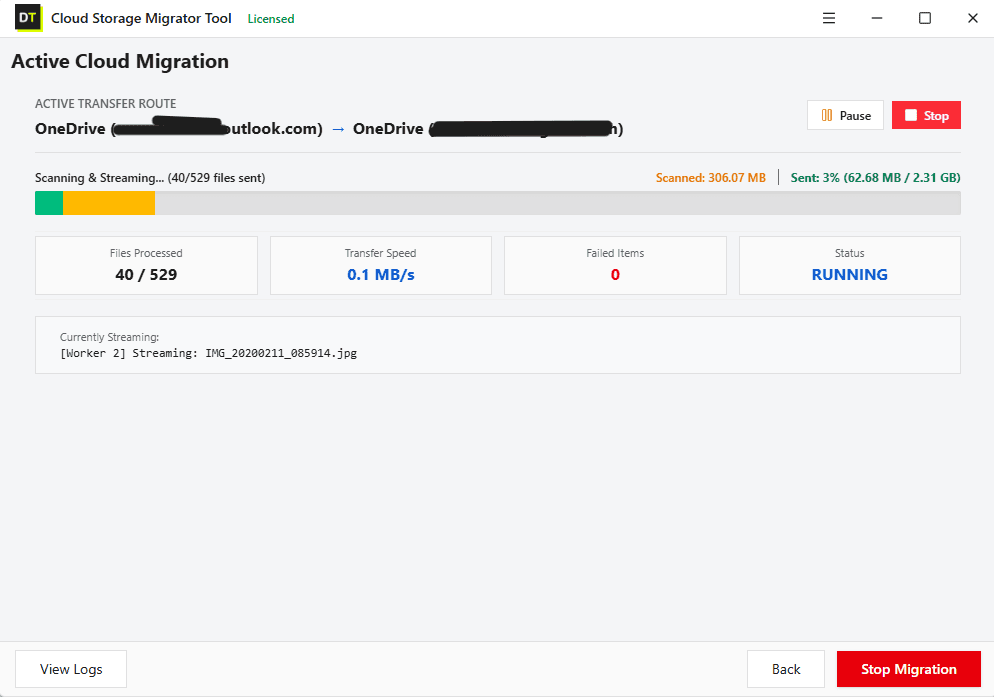
Screen 8: Migration
This is the live screen. Watch the job run between your source and destination clouds with the original folder structure preserved. If your connection drops or you pause the job, the transfer resumes where it stopped. When the run ends you get a detailed job report split into failed items, filtered items and already migrated items, exportable for your records. Nothing happens silently.
Everything Else Included, on Every License
Who Gets the Most From This Tool
Individuals leaving pCloud
You are moving to Google Drive, OneDrive or Dropbox for better app integration, and you want every file and folder to arrive without downloading it all first.
Individuals moving into pCloud
You are building a long-term archive in pCloud and want years of files from other clouds transferred in bulk, with filters and a schedule.
Lifetime plan holders
You want a second copy of your pCloud data in another cloud, kept current with incremental runs, without redoing the whole transfer each time.
Freelancers and small teams
A client shares a project in pCloud, but your workflow lives in Drive or OneDrive. You want to move it once, correctly, and keep the folder structure.
IT admins and companies
You are consolidating storage across pCloud Business and Microsoft 365 or Google Workspace, with CSV mapping and a report for every run. The cost stays predictable because the tool does not charge by the gigabyte.
pCloud Migration Compared: Five Ways to Do It
| Method | How it works | Where it falls short / Advantage |
|---|---|---|
| Manual download and upload | Download from pCloud, upload to the new cloud | Uses your disk and internet twice, restarts on failure, slow for large folders |
| pCloud Drive plus another sync app | Copy between the pCloud virtual drive and another cloud's sync folder | Needs your PC for every byte, hard to filter, no report |
| pCloud's built-in import | Pulls files from a few clouds into pCloud | Built to bring data in, little control over the job, not for moving out |
| Command-line and visual Rclone tools | Configure remotes and run copy or sync jobs | Powerful, but needs setup skill and manual configuration for every job |
| Web-based cloud managers | Add both clouds online and run a transfer | Free plans have transfer limits, heavy use needs a paid subscription |
| DT pCloud Migrator Tool | Guided 8-screen desktop workflow | One-time license, every feature in the build, no data cap on the licensed version |
This comparison reflects publicly available information as of October 2026 and may change. Confirm current details on each provider's own site.
Before You Migrate: A Six-Point Checklist
Confirm you are authorized to move the data, especially on business accounts.
Unlock your Crypto folder if you plan to move its contents, and decide where those files should live afterwards.
Clean duplicates first so you do not move the same file twice. The DT pCloud Duplicate Finder can do this directly on your pCloud account.
Check free space and plan limits on the destination.
Decide your duplicate rule in advance: skip, rename or replace.
Run a small filtered test job first, then the full migration, and keep pCloud active until the report shows everything arrived.
Free Trial vs Licensed Version
| Feature | Free trial | Licensed |
|---|---|---|
| All eight screens and every account path | Yes | Yes |
| Data you can process | Up to 500 MB | No limit |
| File size | Files under 20 MB | No limit |
| Preview, filters and mapping | Yes | Yes |
| Scheduling, incremental runs and job reports | Yes | Yes |
System Requirements
- Installer size8.3 MB
- Architecture32-bit and 64-bit
- Operating systemAll versions of Windows (Windows 11 and 10 recommended) and all versions of Windows Server
- Virtual machinesVMware, Microsoft Hyper-V, Oracle VirtualBox
- Processor2 GHz, 2 cores minimum
- Memory2 GB minimum
- Disk space1 GB minimum
- Prerequisite.NET Framework 4.7 or later on Windows 8 and earlier
Security and Privacy in Plain Words
Your cloud passwords are not stored by Data TB.
MFA works wherever your provider supports it.
The application runs on your own Windows PC, so keep it running while a job or schedule is active.
Data is not stored by Data TB.
You can revoke the tool's access from your cloud provider's security settings at any time.
Files from a pCloud Crypto folder are stored under the destination cloud's security model once they arrive. Review where sensitive files should live before you move them.
Frequently Asked Questions
QWhat is the best way to migrate from pCloud to Google Drive?
Use a migration tool that connects both accounts and moves files directly. In DT pCloud Migrator Tool you sign in to pCloud as the source and Google Drive as the destination, preview and filter the data, map folders and run the job. The folder structure is preserved and the transfer resumes if it is interrupted.
QCan I transfer files from pCloud to OneDrive or SharePoint?
Yes. Connect pCloud as the source and OneDrive, OneDrive for Business or SharePoint as the destination. Preview the files, map them to the right library or folder and start the job. The same steps work for personal and business accounts.
QCan I move files from Google Drive, Dropbox or OneDrive into pCloud?
Yes. Every supported cloud works as a source or a destination, so pCloud can be the destination just as easily as the source.
QCan I transfer from one pCloud account to another pCloud account?
Yes. Connect both pCloud accounts and map folder to folder. This is useful for merging accounts, handing over a project or moving files between a personal and a business account.
QDoes it support pCloud Business accounts?
Yes, as a source or a destination. Many organizations require approval before moving business data, so check your policy first.
QDoes it work with pCloud EU and US accounts?
Yes. pCloud accounts are tied to a data region, and you connect the one your account belongs to.
QWhat happens to my pCloud Crypto folder?
Crypto folders use encryption that only you can unlock. Unlock the folder before migrating its contents, and remember that files arriving in another cloud follow that cloud's own security.
QWill my pCloud shared links still work after migration?
No. Shared links and sharing settings belong to pCloud and are not carried to another cloud. Recreate the links and permissions you need at the destination.
QDoes it download my files to my computer first?
No manual download and upload cycle is needed. You run one job between the two clouds.
QIs there a data size limit?
The licensed version has no limit on total data or file size. The free trial processes up to 500 MB and files under 20 MB so you can test safely.
QWhich cloud storage services are supported?
pCloud, Google Drive, OneDrive, Dropbox, Box, SharePoint, MEGA, Amazon S3, Cloudflare R2, Google Cloud Storage, Azure Blob Storage, Backblaze B2, Nextcloud, DigitalOcean Spaces, Proton Drive, Yandex Disk, TeraBox and FTP or SFTP servers.
QCan I preview and filter what moves?
Yes. The Preview screen shows folders and file details. You can filter by extension, date range, folder type and file size before anything is transferred.
QWhat happens if a file already exists at the destination?
You choose before the run: skip the file, rename the incoming copy so both exist, or replace the existing one.
QCan I keep a second copy of my pCloud data in another cloud?
Yes. Run an incremental job on a schedule and only new or changed files move each time, so the second copy stays current without repeating the full transfer.
QCan I schedule a pCloud migration?
Yes. Run it once, run it incrementally so only new or changed files move, or schedule it hourly, daily, weekly or monthly.
QWhat if the migration is interrupted?
The transfer resumes from where it stopped. You do not start the whole job again.
QDoes it keep my pCloud folder structure?
Yes. The original folder structure is preserved at the destination.
QHow is this different from the DT Cloud Storage Migrator Tool and DT pCloud Suite?
The core engine and features of the migrator are the same as the DT Cloud Storage Migrator Tool; this page focuses on pCloud moves. DT pCloud Suite is a different product that mounts pCloud as a local drive on your PC and is not used for migration.
Ready to Move? Start With the Free Trial
Run a real migration on your own pCloud account, up to 500 MB, before you spend anything. You will see the full workflow working on your data, from sign-in to the final job report. When you are ready for the full job, the licensed version removes every limit, and everything you need is already in one tool.