Key Takeaway: DT Outlook PST Toolkit handles two opposite problems with the same PST file: breaking an oversized PST into smaller, manageable files, or combining several scattered PST files into one. Both operations run through the same interface, the same filtering options, and the same transparent processing log, without needing Outlook installed.
Split or Merge
DT Outlook PST Toolkit
Split Large PST Files or Merge Multiple PST Files Into One
DT Outlook PST Toolkit handles two opposite problems with the same PST file: breaking an oversized PST into smaller, manageable files, or combining several scattered PST files into one. Both operations run through the same interface, the same filtering options, and the same transparent processing log, without needing Outlook installed.


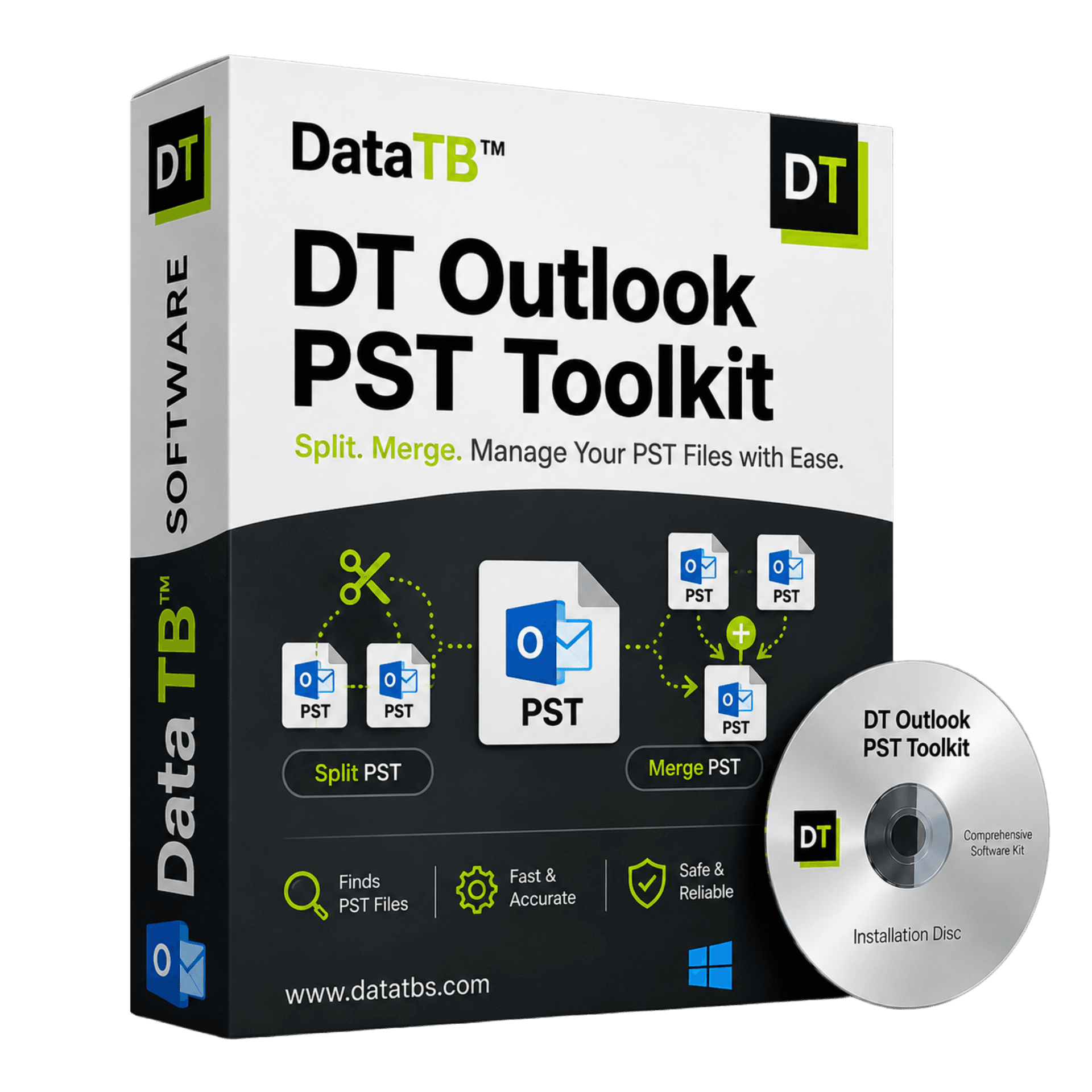
Key Features of DT Outlook PST Toolkit
Two operations, one tool: Split and Merge selected from a single screen at the start, no separate purchase or separate install for each
Three split modes: by file size, by year (a separate PST created for each year), or by top-level folder
Shared filter and cleaning options: exclude Deleted Items/Trash, exclude Junk/Spam, remove empty folders, or strip all attachments, available for both split and merge jobs
Batch file loading: add individual files or an entire folder of PST files at once
No Outlook required: reads and writes PST files through an independent engine
Transparent processing log: a live, timestamped log shows exactly what the tool is doing at every stage, not just a progress bar
Configuration file generated per job: every run creates a JSON config recording the exact settings used, useful for repeating or auditing a job later
No file size limit: large PST files are handled without forcing a workaround first
Split PST Files: When One File Has Become a Problem
A PST file does not fail all at once. It slows down gradually, first a longer wait to open Outlook, then search taking noticeably longer, then errors that only started appearing once the file crossed a certain size. Outlook itself enforces limits on how large a PST file can safely get before performance and stability suffer, and a file already past that point does not fix itself by waiting.
Splitting breaks one oversized PST into several smaller, healthier files, restoring normal Outlook performance without deleting a single email.
Split by File Size
Set a target size and the tool divides the PST into that many parts automatically. The straightforward choice when the goal is simply keeping every resulting file under a specific size limit, for storage, for email attachment limits, or for staying comfortably under what Outlook can handle without slowing down.
Split by Year
Creates a separate PST file for each year found in the mailbox. This is the option most suited to long-term recordkeeping, since a specific year's correspondence stays fully self-contained in its own file, easy to archive, easy to hand off for an audit, and easy to locate later without searching through everything else.
Split by Folder
Splits based on the mailbox's existing folder structure, each top-level folder, Inbox, Sent Items, a custom project folder, exported into its own PST file. Useful when specific folders need to be separated out and handled independently, rather than the whole mailbox needing a size-based or date-based split.
Merge PST Files: When the Data Is Scattered, Not Oversized
The opposite problem is just as common. A five-year employee has old export files stitched together after a laptop replacement, a merged team's PST archives sit in separate files after two departments combined, or years of periodic exports built up into a folder full of disconnected PST files nobody has consolidated.
Merging takes multiple PST files and combines them into a single, unified file, restoring one searchable mailbox instead of several fragments that each need to be checked separately.
Loading files for a merge works exactly like loading files for a split, individual files or an entire folder at once, and the same filtering options apply: excluding Deleted Items, excluding Junk, skipping empty folders, or stripping attachments before the merged file is created, so unwanted clutter does not get carried forward into the consolidated result.
The Same Filters, Whichever Direction You're Working In
Most tools in this category treat splitting and merging as entirely separate products with entirely separate settings to relearn. DT Outlook PST Toolkit uses the same filter and cleaning options for both operations, so switching between the two does not mean starting over on configuration.
Exclude Deleted Items / Trash.
Skip content already marked for deletion instead of carrying it into a new split or merged file.
Exclude Junk Email / Spam.
Leave spam folder content behind rather than preserving it in the result.
Remove / Skip Empty Folders.
Skip folder structure that holds nothing, keeping the resulting file or files cleaner and easier to navigate.
Process Without Attachments.
Strip all attachments from the operation, useful when only the email content and metadata matter, not the files attached to them, and file size needs to stay as small as possible.
How It Works, Split or Merge
Step 1: Choose the Operation
Select PST Split or PST Merge from the first screen. Everything downstream, file loading, filtering, and execution, follows the same layout regardless of which one is picked.
Step 2: Import the PST Files
Add individual files or an entire folder at once. Each file shows its name, size and path before anything runs, so what is loaded is always clear before proceeding.
Step 3: Set the Options
For a split, choose by File Size, by Year, or by Top-level Folder. For a merge, the same filter and cleaning options apply directly to the combined output. Exclude Deleted Items, exclude Junk, remove empty folders, or strip attachments, any combination.
Step 4: Run and Watch the Live Log
Start the operation and watch a live, timestamped log of exactly what is happening, not a silent progress bar. A configuration file is generated automatically for the job, useful for repeating the same settings later or keeping a record of exactly what ran.
A Process You Can Actually Watch, Not Just Wait On
Most split and merge tools show a generic progress bar with no detail behind it. DT Outlook PST Toolkit logs every stage of the job in real time: when the task starts, how many files were loaded, when the configuration file was generated and where it was saved, and when the underlying processing engine launches. Nothing about what the tool is doing is hidden behind a spinning icon with no explanation.
This matters most in a business setting, where a job that fails partway through needs a clear record of what happened before the failure, not just a vague error message. The configuration file generated for every run also means a job's exact settings, split mode, filters applied, files included, are recorded and can be referenced or reused later without reconstructing them from memory.
Situations This Toolkit Actually Solves
A PST file too large for Outlook to handle comfortably.
Split by file size into parts that stay well within a safe operating range.
Old email needing yearly archival structure.
Split by year, one file per year, ready for long-term storage or a compliance retention schedule.
A department's PST files after a reorg.
Merge everyone's scattered files into one consolidated archive, filtering out junk and empty folders along the way.
Cleaning up before either operation.
Strip attachments and skip Deleted Items or Junk on a split or a merge, so the result is not carrying forward clutter nobody actually needs.
A job that needs to be repeated with the exact same settings.
The generated configuration file records precisely what was run, useful for recurring maintenance jobs on the same mailbox structure.
Who Uses DT Outlook PST Toolkit
Anyone with an Outlook that has slowed to a crawl
A single oversized PST file is very often the cause. Split it and get normal performance back without losing anything.
IT administrators managing employee offboarding
Old PST exports pile up over the years. Merge them into a single per-employee archive, or split a departing employee's mailbox by year for retention purposes.
Legal and compliance teams
Splitting a mailbox by year creates clean, self-contained files that map directly onto typical retention and audit requirements.
Anyone consolidating after a device change or team merger
Multiple PST files from old laptops or combined departments get merged into one searchable file instead of staying scattered.
Users hitting Outlook's own PST size limits
Splitting keeps every resulting file safely under whatever size threshold is actually causing the slowdown or the errors.
DT Outlook PST Toolkit: Demo vs Full Version
The demo runs the full workflow exactly as the full version does, choosing the operation, loading files, setting filters, and watching the live log all work identically. Only the final output volume is limited until the full version is activated.
| Feature | Demo Version | Full Version |
|---|---|---|
| Load PST files, single or batch | Included | Included |
| Choose Split or Merge operation | Included | Included |
| All split modes: Size, Year, Top-level Folder | Included | Included |
| All filter and cleaning options | Included | Included |
| Live processing log | Included | Included |
| Configuration file generated per job | Included | Included |
| Complete split or merge output | Limited items per folder | No limit |
| Price | Free | Paid |
System Requirements
Split It Down or Bring It Together, Same Tool Either Way
Whether Outlook has slowed to a crawl under one oversized file or years of exports have scattered into a dozen separate PST files nobody has consolidated, DT Outlook PST Toolkit handles both directions from the same install. Run the free trial against a real file and watch exactly what happens, step by step, before deciding to buy.
Frequently Asked Questions
Is PST Split and PST Merge the same tool, or do I need to buy them separately?
The same tool. Both operations are available from the same install, selected from a single screen, using the same filtering options.
Do I need Microsoft Outlook installed to use this?
No. DT Outlook PST Toolkit reads and writes PST files through its own independent engine, with no dependency on an Outlook installation.
What is the difference between splitting by size and splitting by year?
Splitting by size divides the file into parts that stay under a target file size, useful for storage or performance limits. Splitting by year creates one self-contained PST file per year, better suited to long-term archival and retention needs.
Can I merge PST files and apply filters at the same time, like excluding Junk or Deleted Items?
Yes. The same filter and cleaning options used for splitting, excluding Deleted Items, excluding Junk, removing empty folders, and stripping attachments, apply directly during a merge as well.
Is there a limit on how large a PST file can be for either operation?
No enforced size limit. Large PST files can be split or included in a merge without needing to be broken down manually first.
What does the generated configuration file actually do?
Every split or merge job automatically produces a JSON configuration file recording the exact settings used, which folder or size mode was selected, which filters were applied, and which files were included. It provides a record of the job and can be referenced to repeat the same settings later.
Can I load an entire folder of PST files instead of adding them one at a time?
Yes. Both Split and Merge support adding a full folder of PST files in one step, in addition to selecting individual files.
What happens to attachments if I choose "Process without attachments"?
All attachments are stripped from the operation entirely, whether splitting or merging, leaving only the email content and metadata in the resulting file or files.
Does merging remove duplicate emails automatically?
This tool currently focuses on structural merging rather than deduplication. Duplicate detection during merge is not currently a feature.
What is the difference between the demo and the full version?
The demo runs the complete workflow for both operations, including all filters and the live processing log, with output limited to a set number of items per folder. The full version removes that output limit entirely.